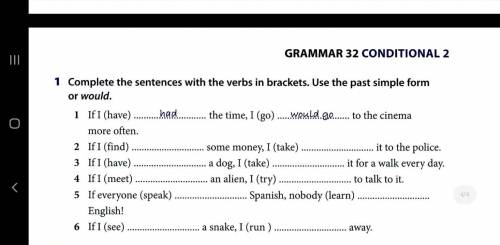
ПО АНГЛИЙСКОМУ complete each sentence. use the correcto form of the verbs un brackets. 1) if jack (not leave) now,he (miss) his bus. 2) if Helen (work) hard,she (pass) her exams. 3) if it (rain) ,se (go) into a shop. 4) if Mary (not practise) her french,she (not improve) 5) if it (rain) tomorrow,we (not go) swimming. 6) if george (come) late,the teacher (be) angry. 7) if i (see) Joe tomorrow,i (tell) him your news.
1) If Jack does not leave now, he will miss his bus.
Explanation: In conditional sentences, we use the present simple tense in the if-clause (e.g., "if Jack does not leave") and the future simple tense in the main clause (e.g., "he will miss his bus").
2) If Helen works hard, she will pass her exams.
Explanation: Again, we use the present simple tense in the if-clause (e.g., "if Helen works hard") and the future simple tense in the main clause (e.g., "she will pass her exams").
3) If it rains, we will go into a shop.
Explanation: In this case, we use the present simple tense in the if-clause (e.g., "if it rains") and the future simple tense in the main clause (e.g., "we will go into a shop"). The word "se" in the original question seems to be a typo.
4) If Mary does not practice her French, she will not improve.
Explanation: In this sentence, we use the present simple tense in the if-clause (e.g., "if Mary does not practice her French") and the future simple tense in the main clause (e.g., "she will not improve").
5) If it rains tomorrow, we will not go swimming.
Explanation: Once again, we use the present simple tense in the if-clause (e.g., "if it rains tomorrow") and the future simple tense in the main clause (e.g., "we will not go swimming").
6) If George comes late, the teacher will be angry.
Explanation: In this sentence, we use the present simple tense in the if-clause (e.g., "if George comes late") and the future simple tense in the main clause (e.g., "the teacher will be angry").
7) If I see Joe tomorrow, I will tell him your news.
Explanation: Lastly, we use the present simple tense in the if-clause (e.g., "if I see Joe tomorrow") and the future simple tense in the main clause (e.g., "I will tell him your news").
Overall, these sentences are examples of conditional sentences type 1, which express real or possible situations in the future. By practicing these types of sentences, students can improve their understanding of grammar and sentence structure in English.















Explanation: In conditional sentences, we use the present simple tense in the if-clause (e.g., "if Jack does not leave") and the future simple tense in the main clause (e.g., "he will miss his bus").
2) If Helen works hard, she will pass her exams.
Explanation: Again, we use the present simple tense in the if-clause (e.g., "if Helen works hard") and the future simple tense in the main clause (e.g., "she will pass her exams").
3) If it rains, we will go into a shop.
Explanation: In this case, we use the present simple tense in the if-clause (e.g., "if it rains") and the future simple tense in the main clause (e.g., "we will go into a shop"). The word "se" in the original question seems to be a typo.
4) If Mary does not practice her French, she will not improve.
Explanation: In this sentence, we use the present simple tense in the if-clause (e.g., "if Mary does not practice her French") and the future simple tense in the main clause (e.g., "she will not improve").
5) If it rains tomorrow, we will not go swimming.
Explanation: Once again, we use the present simple tense in the if-clause (e.g., "if it rains tomorrow") and the future simple tense in the main clause (e.g., "we will not go swimming").
6) If George comes late, the teacher will be angry.
Explanation: In this sentence, we use the present simple tense in the if-clause (e.g., "if George comes late") and the future simple tense in the main clause (e.g., "the teacher will be angry").
7) If I see Joe tomorrow, I will tell him your news.
Explanation: Lastly, we use the present simple tense in the if-clause (e.g., "if I see Joe tomorrow") and the future simple tense in the main clause (e.g., "I will tell him your news").
Overall, these sentences are examples of conditional sentences type 1, which express real or possible situations in the future. By practicing these types of sentences, students can improve their understanding of grammar and sentence structure in English.