1. If it rains tomorrow, I (stay) at home.
Answer: If it rains tomorrow, I will stay at home.
Explanation: In this sentence, we are talking about a possible future situation. The if clause introduces the condition (rain), and the main clause states the result (stay at home). We use the first conditional to talk about real possibilities or future actions.
2. If I were you, I (go) to the party.
Answer: If I were you, I would go to the party.
Explanation: In this sentence, we are talking about a hypothetical situation, something that is not true in the present. The if clause presents an unreal condition (If I were you), and the main clause expresses a hypothetical result (I would go to the party). We use the second conditional to talk about unreal or hypothetical situations.
3. If she studies hard, she (pass) the exam.
Answer: If she studies hard, she will pass the exam.
Explanation: In this sentence, we are talking about a possible future situation based on a condition. The if clause presents the condition (study hard), and the main clause states the result (pass the exam). We use the first conditional to talk about real possibilities or future actions.
4. If I had more money, I (travel) around the world.
Answer: If I had more money, I would travel around the world.
Explanation: In this sentence, we are talking about an unreal or hypothetical situation in the present. The if clause presents an unreal condition (If I had more money), and the main clause expresses a hypothetical result (I would travel around the world). We use the second conditional to talk about unreal or hypothetical situations.
5. If you touch the hot stove, you (burn) your hand.
Answer: If you touch the hot stove, you will burn your hand.
Explanation: In this sentence, we are talking about a cause-and-effect situation. The if clause introduces the condition (touch the hot stove), and the main clause states the result (burn your hand). We use the first conditional to talk about real possibilities or future actions.
Remember that these are just examples, and there can be variations depending on the context and specific verbs used in the brackets. The first conditional is used for real possibilities or future actions, while the second conditional is used for unreal or hypothetical situations.

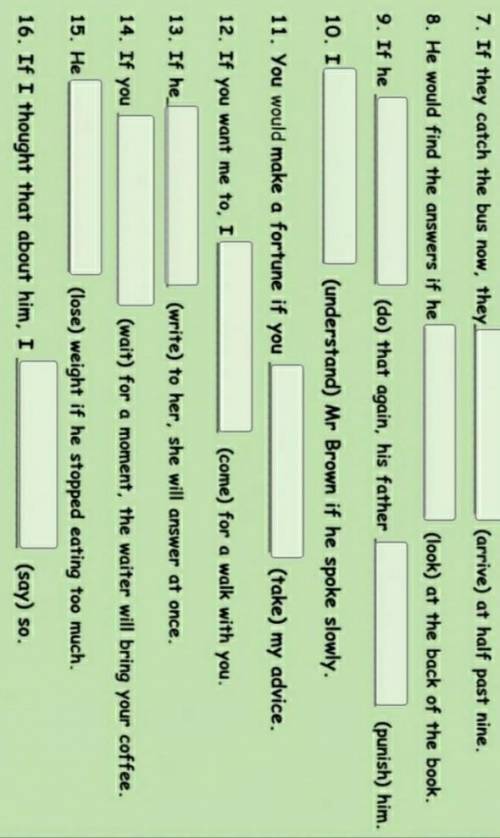













7 will arrive
8 looked
9 do...will punish
10 would understand
11 took
12 will come
13 writes
14 wait
15 would lose
16 would say
Answer: If it rains tomorrow, I will stay at home.
Explanation: In this sentence, we are talking about a possible future situation. The if clause introduces the condition (rain), and the main clause states the result (stay at home). We use the first conditional to talk about real possibilities or future actions.
2. If I were you, I (go) to the party.
Answer: If I were you, I would go to the party.
Explanation: In this sentence, we are talking about a hypothetical situation, something that is not true in the present. The if clause presents an unreal condition (If I were you), and the main clause expresses a hypothetical result (I would go to the party). We use the second conditional to talk about unreal or hypothetical situations.
3. If she studies hard, she (pass) the exam.
Answer: If she studies hard, she will pass the exam.
Explanation: In this sentence, we are talking about a possible future situation based on a condition. The if clause presents the condition (study hard), and the main clause states the result (pass the exam). We use the first conditional to talk about real possibilities or future actions.
4. If I had more money, I (travel) around the world.
Answer: If I had more money, I would travel around the world.
Explanation: In this sentence, we are talking about an unreal or hypothetical situation in the present. The if clause presents an unreal condition (If I had more money), and the main clause expresses a hypothetical result (I would travel around the world). We use the second conditional to talk about unreal or hypothetical situations.
5. If you touch the hot stove, you (burn) your hand.
Answer: If you touch the hot stove, you will burn your hand.
Explanation: In this sentence, we are talking about a cause-and-effect situation. The if clause introduces the condition (touch the hot stove), and the main clause states the result (burn your hand). We use the first conditional to talk about real possibilities or future actions.
Remember that these are just examples, and there can be variations depending on the context and specific verbs used in the brackets. The first conditional is used for real possibilities or future actions, while the second conditional is used for unreal or hypothetical situations.